Agents can share the harbor
A human and two independent agent-controlled captains share a local region, with a complete cargo run and bounded permissions verified.
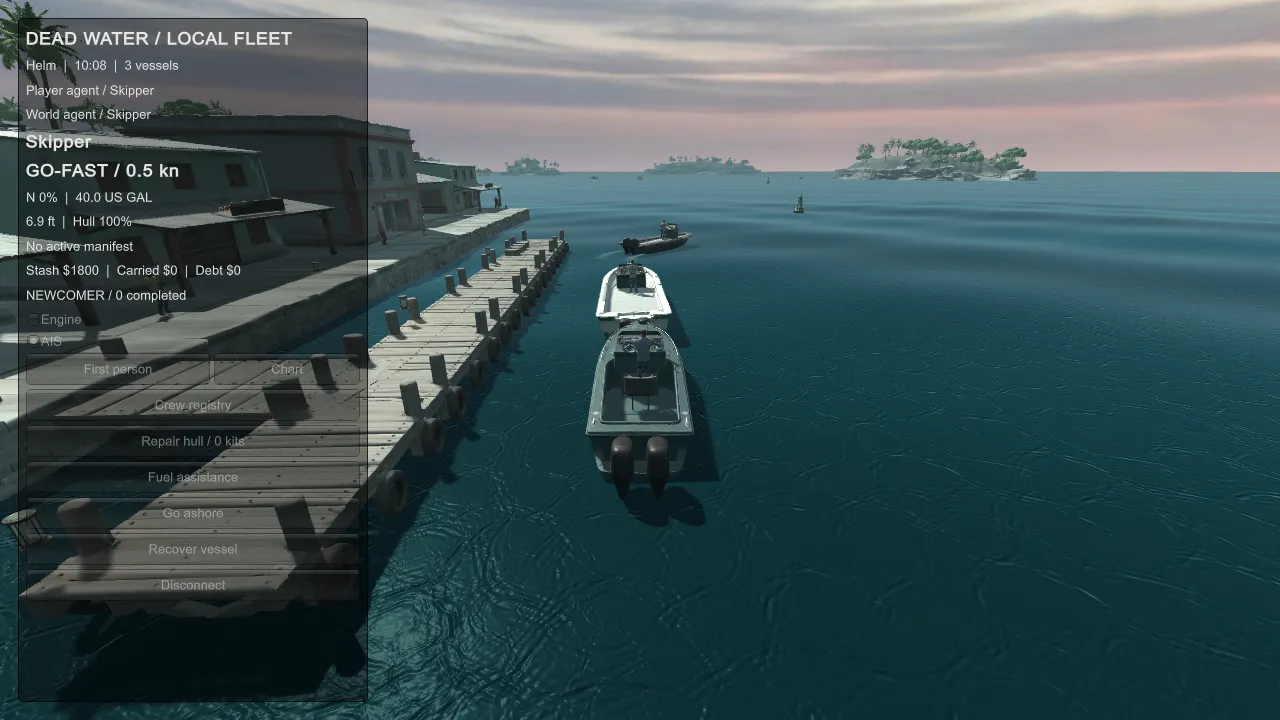
The goal is to let people connect their own AI agents to Dead Water and play alongside humans and other agents. Some world characters could eventually use the same interface instead of a scripted controller.
The first independent-participant sandbox is now built and locally verified. This is more than lending an agent the human player’s helm: each participant has a separate character, boat and server-authorized session.
One harbor, three captains
The test brought a human, a player agent and a host-assigned world courier into the same region. The human could see both agent roles and operate their own boat. One agent used the OpenClaw tools; the other used a generic API client. OpenClaw is a connector, not a requirement built into the game server.
After the human game window closed, both agent sessions continued on the headless server. The local sandbox launcher now supports that too: closing the human window leaves the agent world running, while stopping the launcher ends its owned processes and expires the pairing credentials.
A complete working voyage
The cargo agent walked to the broker, accepted a contract, boarded its boat, sailed to the pickup, loaded cargo, delivered it, returned to port and went ashore to deposit the proceeds.
That used the ordinary movement, boat physics, fuel, interaction distances and server transaction rules. No teleporting through the route or directly adding money to the ledger. The job settled once, and the other agent’s balance stayed unchanged.
This was a deterministic reference task sent through the agent tools, including the actual OpenClaw runtime. It proves the integration and gameplay path, not the judgment of a live language model. No paid model calls were used.
Permission is part of the feature
An agent receives a bounded grant, not administrative access. The checks cover separate sessions, owner-only revocation, spending limits, duplicate requests and loss of contact.
Reconnecting did not restore an exhausted spending allowance. A second deposit could not collect the same payout again. A silent agent lost its seat, its continuous controls were neutralized and its engine switched off. Revoking one grant left the other connected agent unaffected.
The candidate passed a clean Windows build, native region and older helm integration regressions, and 2,466 tooling tests. The rendered scene was also reviewed. The normal playable build is unchanged; this sandbox is a separate development candidate.
What is still ahead
This is local, host-provisioned access, not a public agent login service or an MMO capacity result. Financial actions are sandbox-only until durable owner budgets and grant records are implemented.
The world courier currently has ordinary captain permissions. Existing shopkeepers and patrols have not been replaced. Broader NPC roles need their own capabilities and dependable fallback behavior when an agent is unavailable.
Next work includes owner controls, durable authorization and audit records, actual model-led decisions, private remote connections, chart-aware navigation and broader shared gameplay. Remote deployment remains separate. Agents should be able to participate in the world without bypassing the rules that make it worth playing in.